

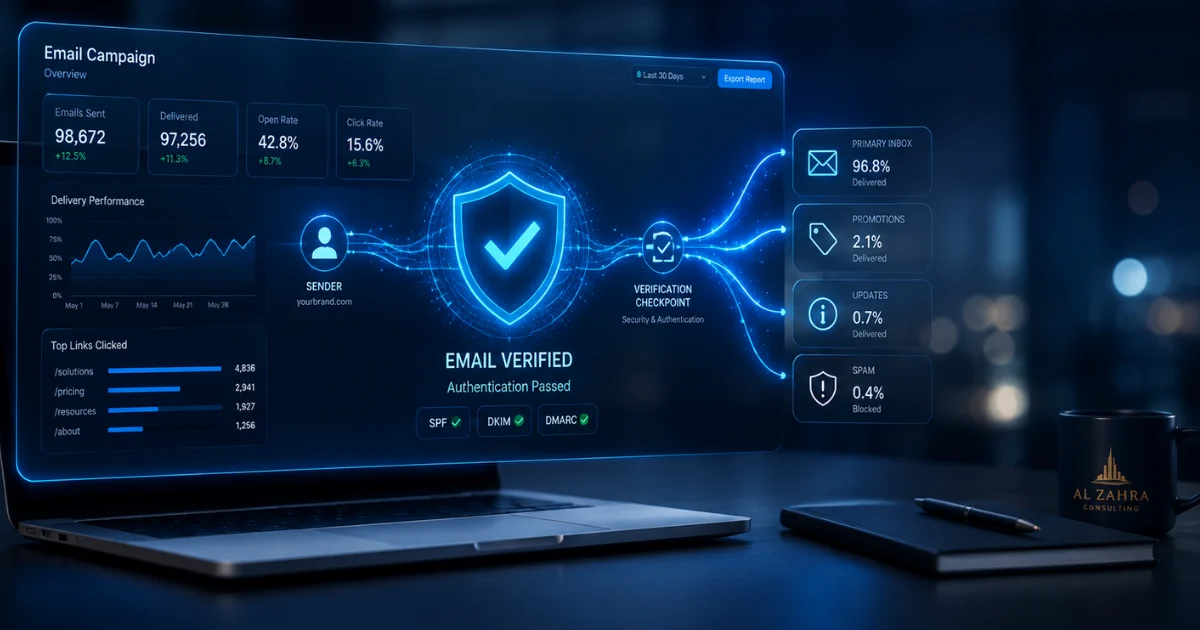
What Does Actually Get Bulk Emails Flagged as Spam?
Internet service providers and mail servers in the UAE run aggressive filtering because phishing and spoofing attempts against local businesses are common. Gmail, Outlook, and regional providers look at sender reputation before they look at content. Email deliverability drops the moment a domain sends volume without a verified sending history. A brand-new domain blasting 5,000 emails in a single afternoon looks identical, to a filter, to a botnet.
Volume alone isn't the problem. Unverified volume is. A domain with no authentication records is essentially handing spam filters a reason to block first and ask questions later.
The Domain Authentication Layer That Changes Everything
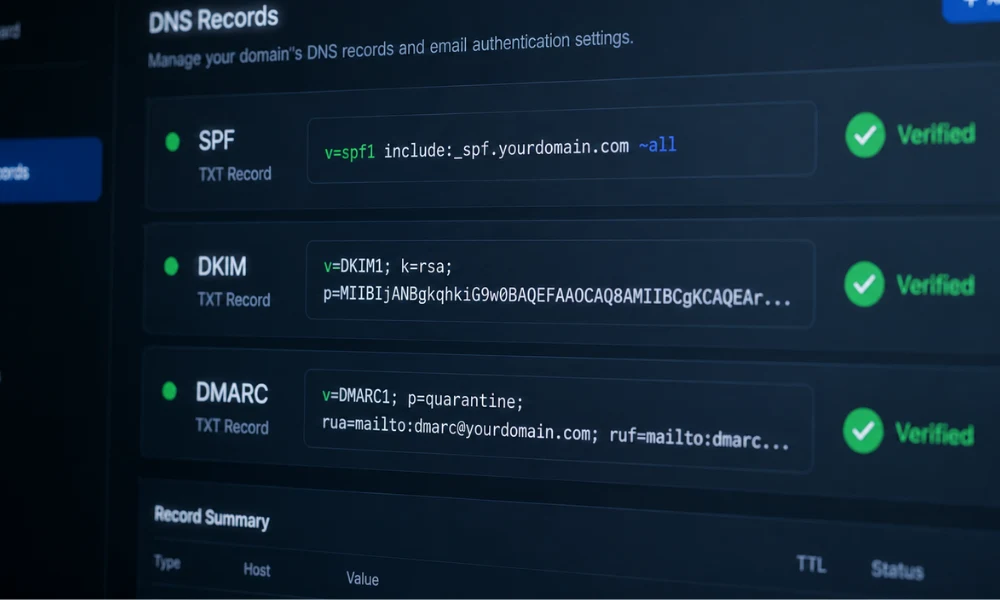
Three technical records decide whether your bulk send lands in an inbox or a junk folder. SPF tells receiving servers which mail servers are allowed to send on your domain's behalf. DKIM attaches a cryptographic signature so the message can't be altered in transit without detection. DMARC ties the two together and tells receiving servers what to do when a message fails those checks. This explains in detail, and it's worth reading if your IT team hasn't touched these settings before. Without all three configured correctly, even a genuinely useful newsletter can get routed straight to spam, no matter how relevant the content is.
Best Practices When You Send Bulk Emails from Dubai
Getting the technical layer right is only half the job. Sending behavior matters just as much. Warm up a new domain gradually. Start with a few hundred emails to your most engaged contacts, then scale up over two or three weeks. Jumping straight to full volume is one of the fastest ways to get a domain blacklisted.
Segment your list before you send anything. A single email blasted to an entire database, regardless of engagement history, produces the bounce and complaint rates that trigger provider-level blocks. Clean your list regularly too. Dead addresses and typos accumulate fast in any CRM, and every bounce chips away at your sender score.
Content and Sending Behavior That Keeps You Out of the Spam Folder
Filters increasingly look at engagement signals, not just technical headers. If recipients delete your emails unread or mark them as spam, that behavior gets logged against your domain reputation for future sends. Keep subject lines specific and avoid the all-caps, exclamation-heavy style that mimics old-school spam. Include a visible, working unsubscribe link. It sounds counterintuitive, but making it easy to opt out reduces spam complaints, which protects deliverability for every email that follows.
Timing plays a role too. Sending in smaller batches rather than one massive blast gives receiving servers time to process your traffic without flagging a sudden spike as suspicious activity.
When Does It Make Sense to Bring in Professional Support?
Plenty of businesses set up SPF, DKIM, and DMARC on their own and never think about it again. Others hit a wall. Usually it's a company running three or four domains, a mix of Microsoft 365 for one team and Google Workspace for another, maybe a legacy Zoho account still forwarding invoices from two years ago. That's when records start conflicting with each other. One subdomain passes DMARC, another silently fails, and nobody notices until a client says they never got an invoice.
Untangling that mess usually takes someone who works in email security services daily, not once a year. Authentication setup isn't really a separate task from email security. It's the same skill set applied to a different problem.
There's also a regulatory side worth knowing about. The UAE treats unsolicited bulk messaging as more than a technical spam issue. The UAE Telecommunications and Digital Government Regulatory Authority guidance lays out what counts as compliant electronic communication, and it's worth a read before scaling any sending program past a handful of clients.
Final Thoughts
Send bulk emails in the UAE comes down to trust signals a server can verify, not creative copywriting. Get SPF, DKIM, and DMARC configured properly, warm up your sending volume, and keep your list clean. Do those three things consistently, and the inbox stops being a mystery. What does your current domain authentication setup look like, and has anyone actually checked it recently?
FAQ
It's almost always a technical trust issue, not a content issue. If your domain lacks SPF, DKIM, or DMARC records, receiving servers can't verify the message actually came from you. That uncertainty alone is enough to route it to junk.
Yes. Spreading a send across several smaller batches instead of one massive blast lets receiving servers process your traffic normally. A sudden spike in volume from a domain with no sending history looks suspicious even when every recipient opted in.
Not without consequences. New domains need a warm-up period where volume increases gradually over a couple of weeks. Sending high volume immediately is one of the quickest ways to get flagged or blacklisted.
SPF lists which servers can send on your behalf. DKIM signs each message so it can't be tampered with. DMARC tells receiving servers what to do if either check fails. All three work together, and missing even one weakens the whole setup.
Unsolicited commercial messaging does carry regulatory weight in the UAE, separate from technical spam filtering. Keeping consent records and honoring unsubscribe requests protects you on both fronts at once.